


Payday Super Has Started: What Small Businesses Need to Check
Updated: 7 days ago
Payday Super has applied since 1 July 2026. It affects payroll, bookkeeping and cash flow. Small business owners, payroll officers and BAS or tax agents should now check that each pay run reaches employees’ super funds on time.
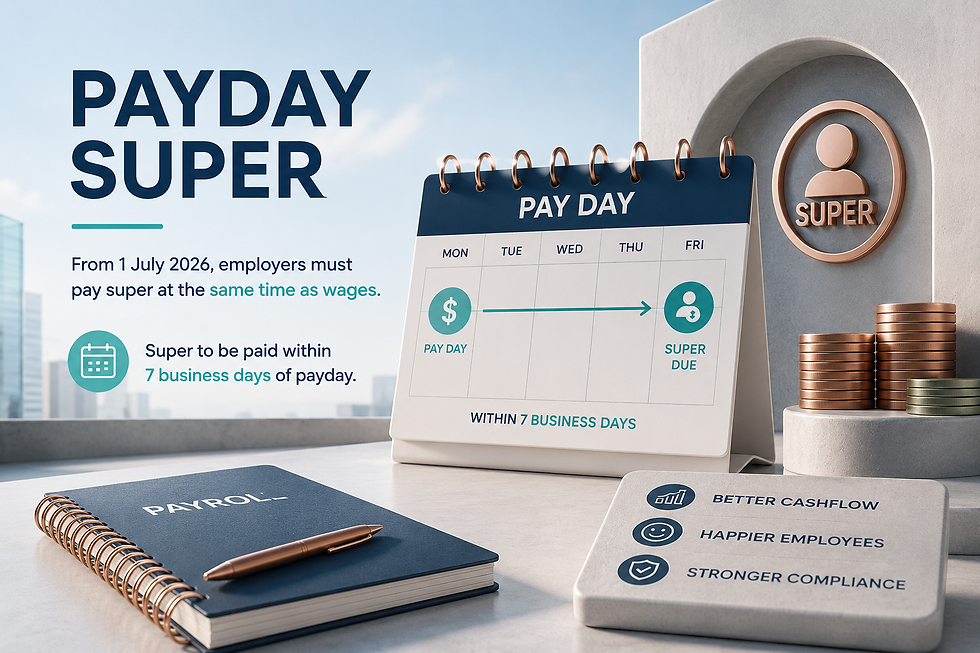
What Payday Super Means for Small Businesses
Payday Super requires employers to pay super with salary and wages. Contributions generally must be received by the employee’s super fund within seven business days after payday. Sending money to a clearing house is not the same as receipt by the fund. Extended timeframes apply in specified circumstances, including some first contributions for new employees.
This change affects businesses that pay employees weekly, fortnightly, or monthly. Superannuation contributions must be calculated and paid alongside wages, not as a separate quarterly task.
How Payday Super Changes Payroll and Cashflow
Small businesses need payroll processes that include super payments every pay cycle. This means:
Including super in each pay run to ensure accurate calculations.
Managing cashflow carefully to cover super payments alongside wages.
Updating payroll software to handle more frequent super payments.
Verifying employee super fund details to avoid rejected payments.
Keeping bookkeeping and bank reconciliations current to track super payments.
Avoiding late or missed payments to prevent ATO compliance issues and penalties.
For example, a small café paying weekly wages generally needs to ensure contributions reach each employee’s fund within seven business days after payday. It should allow for clearing-house processing time.
Checking Payroll Systems for Payday Super
To comply with Payday Super, businesses should:
Check if their current payroll software supports frequent super payments.
Update employee super fund details regularly, including SMSF information if applicable.
Train payroll staff or BAS agents on new payment schedules.
Set reminders or automate payments to avoid delays.
Review cashflow forecasts to accommodate more frequent super payments.
Using payroll software that integrates with the ATO’s systems can simplify compliance and reduce errors. For businesses using SMSF, ensuring timely payments is critical to avoid fund audit issues.
Impact on Bookkeeping and Reporting
Payday Super requires bookkeeping to be more accurate and timely. Businesses must:
Record super payments with each pay run.
Reconcile bank statements regularly to confirm super contributions.
Provide accurate reports for BAS and tax returns.
Monitor super payment deadlines to avoid ATO penalties.
For example, a small retail store that previously updated books quarterly will need to shift to monthly or even weekly bookkeeping to keep up with super payment schedules.

Common Challenges and How to Overcome Them
Many small businesses may face challenges adapting to Payday Super, including:
Cashflow pressure from more frequent super payments.
Errors in employee super fund details causing payment rejections.
Payroll software limitations that do not support frequent payments.
Lack of awareness or training on new compliance rules.
To overcome these challenges:
Plan cashflow carefully and set aside funds for super payments.
Regularly verify employee super fund details, especially for SMSF members.
Upgrade or switch to payroll software that supports Payday Super.
Seek advice from BAS or tax agents to ensure compliance.
Why Compliance Matters
Late or insufficient super can trigger the super guarantee charge and other consequences. If a payment is late, rejected or missing, check the ATO’s current guidance and get help promptly. First-year ATO compliance guidance does not remove the payment obligation.
Staying compliant protects employees’ retirement savings and helps businesses avoid costly fines. It also simplifies end-of-year reporting and reduces administrative burdens.
Keep Checking Each Pay Run
Payday Super is now part of ordinary payroll. Check fund details, clearing-house processing times, rejected payments and cash flow regularly, and keep records of each pay run.
Business owners and payroll officers should work closely with BAS and tax agents to understand their obligations and implement necessary changes. Taking action now ensures super payments are timely, accurate, and compliant.
Next step: Review your payroll and bookkeeping processes today. Confirm the software and payment service are working together, check employee fund details and follow up any payment that has not reached the fund.
Latest checklist and official guidance
General information only, updated 6 September 2026. Speak with us about your payroll circumstances.


Comments